
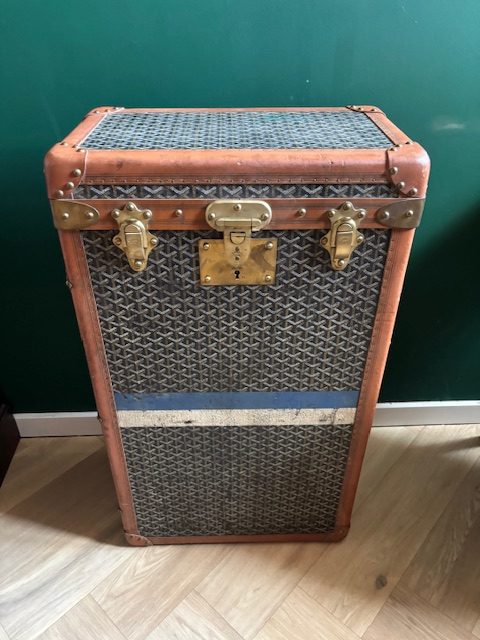
Ask any serious collector to name the two greatest French trunk makers and the same two names come back: Goyard and Louis Vuitton. Both were founded in 19th-century Paris, both dressed royalty and film stars, and both still trade for serious money on the vintage market today. Yet a genuine Goyard trunk and a vintage Louis Vuitton trunk are very different objects, in canvas, construction, rarity and value. At Pinth we handle both houses every week, and this guide sets out the six differences that matter most before you buy, sell or restore.

Goyard vs Louis Vuitton: Two Houses, Two Philosophies
The rivalry is older than the brands many people assume. Maison Goyard traces its origins to 1792, when Pierre-Francois Martin opened a trunk and box-making workshop in Paris; the Goyard name itself dates to 1853, when Francois Goyard took the house over. Louis Vuitton opened his own atelier in 1854. So the two houses grew up side by side, often competing for the same aristocratic clients along the Rue Saint-Honore and the Rue Scribe.
Where they diverged was philosophy. Louis Vuitton industrialised early, scaled production, and built a global brand that today sells across hundreds of stores and online. Goyard stayed deliberately discreet: a tiny number of boutiques, no e-commerce, no advertising, and a culture of bespoke commissions for a clientele that preferred to be invisible. That difference in DNA explains almost everything you see in the vintage market a century later, and it is the reason a genuine Goyard trunk feels rarer in the hand than its LV equivalent.
Difference 1: The Canvas, Chevron vs Monogram
The fastest way to tell the houses apart is the surface. Goyard’s signature is the Goyardine: a chevron of small hand-applied dots that form an interlocking “Y” pattern, a nod to the family’s weaving heritage. It was created in 1892 by Edmond Goyard and was originally painted by hand, dot by dot, which is why early examples show subtle irregularities no machine would produce.
Louis Vuitton’s answer is the Monogram canvas, designed in 1896 by Georges Vuitton in memory of his father. It combines the interlaced LV initials with quatrefoils and stylised flowers, motifs drawn from the Japonisme then sweeping Paris. Before the Monogram, LV used the grey Trianon canvas, the striped Rayee and, from 1888, the Damier checkerboard, so a vintage Louis Vuitton trunk will not always carry the pattern most buyers expect.
In short: a repeating chevron of dots means Goyard; interlocking LV initials with flowers means Louis Vuitton. Colour is another clue. Goyard historically offered the chevron in a range of tones and bespoke colours, while classic LV Monogram stays brown on tan.
Difference 2: Construction and Materials
Both houses build on the same honest skeleton: a lightweight poplar frame, hand-set hardware and a coated canvas skin. The differences are in the detail.
Goyardine is a coated linen, cotton and hemp blend, famous for being remarkably light, an advantage that mattered enormously in the age of porters and ocean liners. Louis Vuitton’s coated cotton canvas is slightly heavier but extremely hard-wearing, and the maison paired it with thick vegetal-tanned leather (Vachetta) trim and lozine edging.
On hardware, Louis Vuitton standardised brass locks stamped with a serial number, repeated on the matching keys, a system collectors now rely on for dating. Goyard tended toward more understated fittings and, true to its bespoke culture, a wider variety of lock and corner treatments. When you handle a Goyard commode trunk next to a Louis Vuitton wardrobe trunk, the LV piece usually feels more standardised and the Goyard more individual.
Difference 3: Rarity and Production Numbers
This is where the two houses separate most sharply. Louis Vuitton produced trunks at scale for well over a century, which means a healthy number survive today, in every size and condition. That abundance is good news for buyers: there is almost always a comparable piece on the market, and prices are easier to benchmark.
Goyard produced far fewer trunks, kept fewer records public, and served a smaller circle of clients. Genuine antique Goyard pieces simply come up less often, and special commissions, exotic colours or named provenance can be genuinely scarce. A vintage Goyard suitcase or a Goyard wardrobe trunk is, all else equal, the rarer find. For collectors who value scarcity above brand recognition, that rarity is precisely the appeal.

Difference 4: Hallmarks, Stamps and Authentication
Authentication starts with the maker’s marks, and the houses stamp themselves differently.
Louis Vuitton trunks carry the Louis Vuitton Malletier a Paris mark, often with an address, brass locks bearing a hand-stamped number, and, from 1980 onward, a date code on a small leather tab. Earlier pieces rely on lock numbers, canvas alignment and construction for dating. For a full walkthrough of LV date codes and checkpoints, see our Louis Vuitton Alzer 75 guide.
Goyard pieces typically show a stamp referencing the house and its historic 233 Rue Saint-Honore address, sometimes with the maker’s name and the chevron applied right up to the trim. Because the chevron was hand-painted on older pieces, the consistency, spacing and wear of the pattern is itself an authentication tool. With both houses, the golden rule is the same: never authenticate on the logo alone. Frame, hardware, stitching and interior must all agree. When in doubt, ask a specialist before money changes hands.
Difference 5: The Collector Market and Value
Both houses hold their value well, but they behave differently as assets.
Louis Vuitton is the more liquid market. Because supply is deeper and recognition is global, a vintage Louis Vuitton trunk is easier to value and easier to sell, with a broad price ladder from accessible cabin trunks to museum-grade special orders. A characterful piece such as a 1930s Louis Vuitton XL trunk or a Louis Vuitton coffee table trunk sits in a well-traded segment.
Goyard is the connoisseur’s market. Thinner supply means fewer comparables, so values can swing more on condition, colour and provenance, and the very best pieces, rare colours, documented ownership, unusual forms, can command a striking premium precisely because they so rarely surface. In practice, Louis Vuitton is the safer bet for liquidity, while Goyard is the play for collectors chasing scarcity and the quiet flex of a piece most people cannot even identify.
Difference 6: Restoration and Patina
How a trunk ages, and how it can be brought back, is the final practical difference.
Louis Vuitton’s Vachetta leather and Monogram canvas patina in a way collectors prize, and because LV materials are comparatively well understood and available, sympathetic restoration is more straightforward. The Vachetta darkens with time and should never be artificially treated.
Goyardine demands more care. The hand-applied chevron is harder to match and reproduce, so restoring a damaged Goyard canvas is a more delicate, specialist job, and over-restoration can erase the very irregularities that prove authenticity. With both houses the principle holds: conserve before you restore, document every replacement part, and work only with specialists who understand antique trunks rather than general leather repairers. A well-kept antique Goyard wardrobe trunk or vintage Louis Vuitton trunk rewards patience over intervention.
Goyard vs Louis Vuitton: Which Should You Collect?
There is no wrong answer, only different goals. Choose Louis Vuitton if you want a deeper market, easier authentication, simpler restoration and stronger resale liquidity. Choose Goyard if rarity, discretion and individuality matter more to you than brand visibility, and you are prepared to hunt for the right piece and care for it accordingly.
Many of the collectors we work with end up owning both: a Louis Vuitton trunk as the anchor of a collection, and a vintage Goyard trunk as the rarer counterpoint. Together they tell the whole story of French malletier craftsmanship.
Goyard and Louis Vuitton Trunks at Pinth
Every piece we offer is authenticated, honestly described and, where relevant, professionally restored. You can browse our curated Louis Vuitton collection, which is refreshed monthly, and we regularly source genuine Goyard pieces on request. If you own a Goyard or Louis Vuitton trunk and are considering selling, we are actively buying, submit a few photographs and any provenance through our we-buy page to start a valuation. For a specific request, use the trunk inquiry form, or read more about authentication and restoration in our services.
Frequently Asked Questions
Is Goyard older than Louis Vuitton?
In origin, yes. Maison Goyard traces back to 1792 and took the Goyard name in 1853, a year before Louis Vuitton opened in 1854. The signature patterns came later: Goyard’s chevron canvas in 1892 and Louis Vuitton’s Monogram in 1896.
Are vintage Goyard trunks rarer than Louis Vuitton trunks?
Generally yes. Goyard produced far fewer trunks and served a smaller, more private clientele, so genuine antique Goyard pieces surface less often than vintage Louis Vuitton trunks, which were made at much greater scale.
How can I tell a Goyard trunk from a Louis Vuitton trunk?
Look at the canvas first. A chevron of small dots forming a “Y” pattern is Goyard; interlocking LV initials with flowers and quatrefoils is Louis Vuitton Monogram. Then confirm with the maker’s stamps, lock numbers, frame and interior, never on the logo alone.
Which holds value better, Goyard or Louis Vuitton?
Louis Vuitton is more liquid and easier to value because supply and recognition are greater. Goyard can command higher premiums for rare colours, bespoke forms or documented provenance, but its thinner market makes values more variable.
Can a Goyard or Louis Vuitton trunk be used as a coffee table?
Yes. Both make superb interior pieces, and coffee-table conversions are among the most popular ways collectors display vintage trunks today, provided the conversion is reversible and respects the original structure.
Final Thoughts
Goyard and Louis Vuitton are not rivals so much as two answers to the same question: how do you build the finest trunk in the world? Louis Vuitton answered with scale, consistency and a global language of luxury. Goyard answered with discretion, rarity and a hand-painted chevron that still resists imitation. Knowing the six differences above, canvas, construction, rarity, hallmarks, value and restoration, lets you buy with confidence and collect with intent. If you have a Goyard or Louis Vuitton trunk you would like an honest opinion on, the Pinth team is always glad to help.
