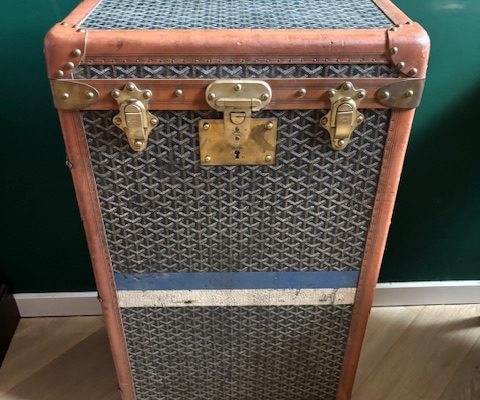
Ask a serious collector which house invented the modern travel trunk, and many will say Moynat before they say Louis Vuitton. Founded in Paris in 1849, five years before Vuitton opened his own atelier, Moynat is the world’s oldest trunk maker, and its story runs from hand-stitched wicker trunks and gutta-percha waterproofing to a twenty-first-century revival under LVMH chairman Bernard Arnault. At Pinth we source, authenticate and sell genuine Moynat pieces, and this guide sets out what a collector needs to know before buying: the history, the hallmarks, the rarity and the value of a Moynat trunk.

A Brief History of Moynat, the World’s Oldest Trunk Maker
Moynat’s story runs longer than most people expect, and it falls into two very different chapters: more than a century of continuous Parisian craftsmanship, then a long silence, then a deliberate revival.
1849. The house is founded in Paris by Octavie and Francois Coulembier, who bring in travel-goods specialist Pauline Moynat to run the workshop. Her name eventually becomes the house’s own.
1854. Moynat patents one of its first inventions in packaging materials, becoming the first trunk maker to waterproof its trunks and boxes with hardened gutta-percha, years ahead of the canvas treatments used elsewhere.
1869. The house opens a boutique on what is now the Place Andre Malraux, directly opposite the Comedie-Francaise, cementing its position among the grand malletiers of central Paris.
Early 1870s. Pauline Moynat introduces the wicker “English trunk”, a lighter construction that becomes one of the house’s signature early products.
Early 1900s. Designer Henri Rapin introduces the hand-painted “M” monogram, the mark that still identifies genuine Moynat canvas today.
1902. Moynat patents the Limousine trunk, a curved case built specifically to follow the sloping boot line of the earliest automobiles. The patent is never successfully copied, and original examples are now among the most sought-after pieces in the vintage market.
1900s-1930s. Moynat’s golden age. The house produces trunks for travel by rail, road and sea, including specialist forms such as hatboxes, wardrobe trunks and, during the First World War, functional medical and military trunks like the piece pictured above.
1976. After more than a century in business, the Moynat house closes. Production stops, and for over three decades the name exists only in the antique and vintage market.
2010. Bernard Arnault, chairman of LVMH, personally acquires the rights to the Moynat name through his holding company Groupe Arnault and appoints designer Ramesh Nair as creative director, with Guillaume Davin as president, to revive the house.
2011. Moynat reopens with a flagship boutique at 348 Rue Saint-Honore in Paris, close to where the original house traded more than a century earlier.
Today. The revived Moynat operates a small number of boutiques worldwide, in the same deliberately discreet spirit as the original house. For collectors, this creates two distinct markets: pre-1976 antique and vintage Moynat trunks, which are what Pinth specialises in, and new pieces from the revived maison, which are a different proposition entirely.
What Sets a Moynat Trunk Apart
Where many nineteenth-century malletiers relied on standard rectangular boxes, Moynat built its reputation on genuine invention. The house’s early gutta-percha waterproofing, patented in 1854, meant a Moynat trunk could survive a transatlantic crossing in a way ordinary canvas trunks could not, and the treatment is still visible today as a distinctive dark, slightly glossy coating beneath the surface pattern on the earliest pieces.
Construction follows the same honest logic seen across the great Parisian houses: a lightweight poplar frame, hand-set brass hardware and a canvas or leather skin stretched and tacked by hand. What is distinctly Moynat is the surface. The hand-painted “M” monogram introduced in the early 1900s appears on most twentieth-century pieces, while earlier and later examples can carry a checkerboard “damier” canvas or, for the house’s most exclusive commissions, full exotic leathers such as crocodile. The Limousine trunk’s curved profile, patented in 1902 specifically to match the sloping boot line of early motorcars, remains one of the clearest signatures of the house’s engineering ambition, and an original example is instantly recognisable next to the flat-sided trunks most other makers produced at the time.

How to Identify and Authenticate a Genuine Moynat Trunk
Authenticating a Moynat trunk starts, as with any historic malletier, at the maker’s marks. Genuine pieces typically carry a stamped reference to the house and its Parisian address, alongside a hand-painted or stencilled “M” monogram whose brushwork should show the small, human irregularities of hand application rather than the perfect repetition of a printed pattern. Hardware is the second checkpoint: locks and corner fittings should match in age and patina, with numbering or stamping consistent across the piece, and any replaced lock should be disclosed rather than hidden.
The most important distinction for a buyer, though, is chronological. A pre-1976 trunk, whether a 1920s hatbox or a wartime medical case, is an antique from the original house and behaves like one: it should show honest wear, period-correct interior lining and construction consistent with its stated decade. A trunk from the house’s 2010 revival is a different object entirely, made to modern standards under Ramesh Nair’s direction and sold new through Moynat’s own boutiques, not through the vintage market. Never authenticate on the monogram alone. Frame, stitching, hardware and interior all need to agree, and a specialist opinion is worth seeking before money changes hands, exactly as we recommend for Goyard and Louis Vuitton trunks.
Moynat Trunk Types Collectors Look For
Because Moynat traded for well over a century before its 1976 closure, and continues today with a small revival collection, the antique and vintage market spans several distinct object types, and collectors tend to gravitate toward one or two.
Wardrobe trunks, tall cases designed to stand upright and hold hanging garments, are among the most impressive pieces to own and display; our antique Moynat wardrobe trunk is a good example of the type. Cabin and malle cabine trunks were built for stateroom travel and are more compact, like this Moynat damier cabin trunk, this vintage Moynat cabin trunk in M-pattern canvas or this antique malle cabine. Hatbox trunks, a smaller specialist form, turn up less often; we previously offered this 1920s Moynat damier hatbox trunk. Military and medical trunks, built for functional field use rather than display, are rarer still, illustrated by the Moynat medical trunk from the First World War pictured earlier in this guide. At the most exclusive end sit exotic-leather commissions such as this vintage Moynat crocodile leather suitcase, which show the house working entirely outside its standard canvas production.
All of the pieces above have already found new homes through Pinth; we list them here to show the range of what genuine Moynat trunks look like, not as current stock. If you are hunting for a specific type, our trunk inquiry form is the fastest way to have us search on your behalf.

How Rare Is a Vintage Moynat Trunk?
How rare is a genuine Moynat vintage trunk? Rarer, on the whole, than a comparable Louis Vuitton piece, and closer in spirit to Goyard, as we explain in our comparison of Goyard and Louis Vuitton trunks. Louis Vuitton produced trunks continuously and at industrial scale for well over a century, so a healthy population survives in every size and condition. Moynat’s production stopped in 1976, which puts a hard ceiling on how many genuine antique and vintage examples can ever exist, and the house was never as large a producer as Vuitton even at its peak.
That scarcity is compounded by the object types themselves. Military and medical trunks were built to be used, not preserved, so survivors are genuinely uncommon. Hatboxes and exotic-leather commissions were always a small share of production. In practice, this means a collector searching specifically for a Moynat trunk, rather than trunks in general, should expect a longer search and be prepared to act when a well-documented piece does appear.
What Determines the Value of a Moynat Trunk
Four factors drive the value of a Moynat trunk, and they apply whether you are buying, selling or having a piece appraised.
Condition and honesty of restoration come first: original hardware, original interior lining and canvas or leather that has aged rather than been over-treated all add value, while heavy-handed restoration that erases original material typically reduces it. Era matters almost as much: a documented pre-1976 antique carries a different weight, and usually a different price, than a piece from the post-2010 revival. The monogram itself is a value signal too, since early hand-painted examples show the small variations of manual work, and a crisp, uniform “M” on a supposedly antique piece is worth questioning. Finally, object type and provenance play a real role: a rare form such as a hatbox or a military trunk, or a piece with a documented ownership history, will typically outperform a common cabin trunk in otherwise similar condition.
As with any vintage luxury purchase, value is easier to judge with a specialist eye on the piece, ideally in person or through detailed photographs of the marks, hardware and interior.

Buying a Moynat Trunk, Near You or Anywhere in the World
Searching for a “Moynat near me” is a natural instinct, but the vintage Moynat market does not really work by geography. Genuine antique and vintage pieces surface irregularly, in private collections, estate sales and with specialist dealers across Europe, the US and beyond, and the right trunk for you is far more likely to come from a trusted source than from a shop on your own street.
At Pinth we work with collectors internationally: we ship worldwide, we can arrange viewings by appointment, and we are always sourcing new pieces, including specific requests for a particular Moynat type or era. If you already own a Moynat trunk and are considering selling, our we-buy page is the place to start a valuation, with no obligation. If you are searching for a specific piece, use our trunk inquiry form and we will search on your behalf. And if you need honest advice on authentication, restoration or care, our services page sets out how we can help.
Moynat Trunks at Pinth
Moynat’s position as the world’s oldest trunk maker is not a marketing claim, it is a documented fact stretching back to 1849, through a golden age of hand-painted monograms and automobile-era engineering, a silence of more than three decades, and a careful twenty-first-century revival. For collectors, that history is exactly what makes a genuine antique or vintage Moynat trunk worth pursuing: fewer survive than from Louis Vuitton, they carry the same French malletier craftsmanship as Goyard, and each one comes with a specific, traceable story. If you have a Moynat trunk you would like an honest opinion on, or you are searching for your first piece, the Pinth team is always glad to help.