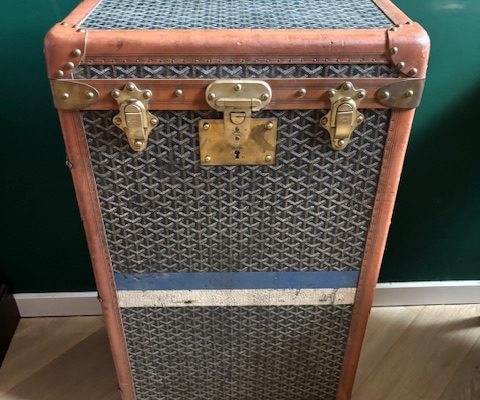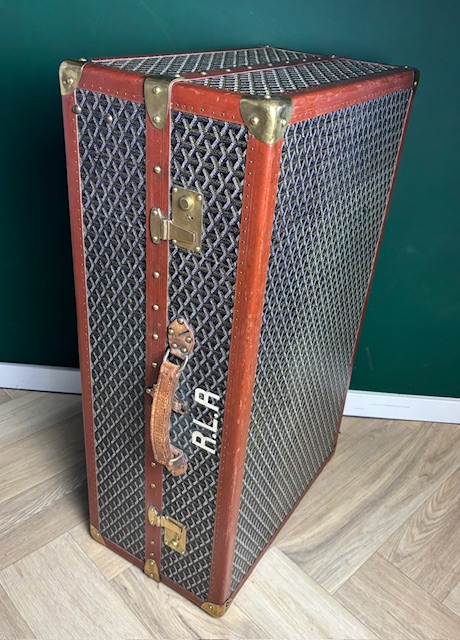
A Goyard trunk is one of the few pieces of antique luggage that can be identified from across a room and still be difficult to authenticate up close. The house painted its canvas by hand, rarely marked its trunks inside, and has never published an authentication database. That combination makes the Goyardine chevron both the most recognisable signature in vintage luggage and the most widely imitated. At Pinth we buy, restore and sell antique Goyard pieces, and this guide sets out what we look at first: where the house came from, what the pattern actually means, which hallmarks matter on a trunk rather than a handbag, and what drives the value of a genuine example.
From Maison Martin to Maison Goyard
The house collectors know as Goyard is older than its name, and the succession explains a great deal about why early pieces look the way they do.
1792. Pierre-Francois Martin founds Maison Martin in Paris, specialising in box-making, trunk-making and packing for the aristocracy. This is the workshop that eventually becomes Goyard.
1845. Louis-Henri Morel, who has inherited the business, takes on a young apprentice named Francois Goyard (1828-1890).
1853. Morel dies unexpectedly the year before, and Francois Goyard takes over the house. He renames it Maison Goyard and runs it for the next three decades, expanding it well beyond what Martin had built.
1885. Francois hands the house to his son, Edmond Goyard, who turns a respected Parisian trunk-maker into a recognisable marque.
1892. Edmond creates the Goyardine canvas. At a time when rival trunk-makers were still covering their cases in plain linen cloth, a printed and hand-finished canvas was a genuine technical advance, and it is the single most important date for anyone identifying a Goyard piece today.
What the Chevron Actually Means
Most guides describe the Goyardine as a chevron pattern and stop there. The design is more deliberate than that, and knowing the logic helps you read a canvas properly.
The pattern is built from small dots rather than solid lines. Those dots reference the log drives that Edmond Goyard’s ancestors worked on, floating timber down French rivers. Arranged together, the dots form a triple chevron that interlocks into the shape of a letter Y, the central letter of the Goyard name.
For identification this matters in two ways. First, the dots should read as individual marks under close inspection, not as a smooth printed line. Second, because the canvas was finished by hand, small irregularities in spacing and alignment are normal on a genuine antique piece. A pattern that is too perfect, too glossy or too evenly machine-printed is a warning sign rather than a reassurance. If you are weighing a Goyard against a Vuitton piece, our guide to the differences between Goyard and Louis Vuitton trunks covers the construction distinctions in more detail.

Marquage: The Hand-Painted Personalisation
Goyard’s marquage is the practice of hand-painting a client’s initials, coloured bands and sometimes a crown or emblem onto the trunk. It is still done by hand in the maison’s ateliers today, and on antique pieces it is one of the most useful things a buyer can examine.
Genuine marquage shows the hand that applied it. Brush edges are crisp but not mechanical, the paint sits on the canvas rather than under a later varnish, and the stripes follow the trunk’s proportions rather than a template. Original marquage also tends to carry provenance: a set of initials, a family crest or a hotel marking can tie a trunk to a named owner and materially change what it is worth.
Be aware that marquage is also added later, sometimes decades later, and sometimes by people who are not Goyard. Repainted initials are not automatically a problem, but they are not original provenance either, and they should be priced accordingly.
Hardware, Locks and Why Trunks Are Harder Than Handbags
Almost every Goyard authentication guide online is written for handbags. Those guides talk about heat stamps reading MADE IN FRANCE and serial numbers in a three-letter, six-digit format. That advice is useful for a tote. It is close to useless for a trunk from 1910.
Antique Goyard trunks were rarely marked internally in any consistent way, and the house has never released a public register of serial numbers or an online authentication tool. What you are left with is the physical evidence:
Locks and brass. Engraved brass locks are one of the more reliable indicators on a trunk. Look at the quality of the casting, the depth and evenness of the engraving, and whether the lock is correct for the claimed period.
Fittings and nails. Original hardware is consistent across the piece. Mixed nail heads, modern screws, or fittings that do not match the wear pattern of the canvas usually mean the trunk has been rebuilt.
Interior. Original trays, linings and paper labels are frequently the first thing lost. A trunk with intact original interior fittings is meaningfully rarer than one that has been relined.
Wear that makes sense. A hundred-year-old trunk should show wear where a hundred-year-old trunk gets handled: corners, edges, base, lock plate. Even, all-over distressing is often artificial ageing.
This is the point at which an honest guide has to say that reading these signals reliably takes handling a lot of trunks. If you have a piece you are unsure about, our valuation and advisory service exists precisely for this.
What Determines the Value of a Goyard Trunk
Two Goyard trunks of the same age and shape can be far apart in value. The variables that move the number most are:
Form and rarity. Purpose-built shapes are worth more than standard cases. A car trunk built to fit an early automobile, a square hatbox or a fitted wardrobe trunk sits above a plain cabin trunk of the same date.
Condition of the canvas. Because the Goyardine is hand-finished, canvas damage is difficult and expensive to restore invisibly. Original canvas in good order is the single biggest value driver.
Originality. Original interior, original hardware, original marquage. Each element that is still the trunk’s own supports the price; each replacement reduces it.
Provenance. Documented ownership, or marquage that identifies a family or institution, adds a premium that has nothing to do with the object’s condition.
Size and usability. Larger wardrobe trunks are impressive but harder to place in a modern home. Pieces that work as furniture, such as a Goyard coffee table trunk, have a broader market than their rarity alone would suggest.
Buying and Selling a Goyard Trunk
Pinth holds one of the larger private collections of antique Goyard in Europe alongside our Louis Vuitton, Hermes and Moynat pieces. Every trunk we sell is inspected, authenticated and, where appropriate, restored by specialists who work on this material regularly.
If you are looking to buy, our current collection shows what is available now, and we can source specific forms on request through our trunk inquiry service. If you have inherited or acquired a Goyard piece and want to know what it is, we buy trunks and will give you an honest assessment of what you have, whether or not you decide to sell it to us.
Frequently Asked Questions
How can I tell if a Goyard trunk is genuine?
Start with the canvas. The Goyardine is built from hand-applied dots forming a Y-shaped triple chevron, so a genuine antique piece shows small irregularities rather than machine-perfect repetition. Then check the brass locks and fittings for quality and period-correct engraving, and look for wear in the places a trunk is actually handled. Because Goyard rarely marked trunks internally and publishes no authentication database, serious pieces should be assessed by a specialist.
Do Goyard trunks have serial numbers?
Not in the way modern Goyard handbags do. The three-letter, six-digit serial format quoted in handbag authentication guides does not reliably apply to antique trunks. Some pieces carry numbers stamped into the lock or hardware, but the absence of a serial number on an antique trunk is not by itself evidence that it is not genuine.
When was the Goyardine chevron canvas created?
Edmond Goyard created the Goyardine in 1892. Any piece presented as Goyard chevron canvas from before that date is misattributed.
Is Goyard older than Louis Vuitton?
The workshop is. Maison Martin, the business that became Goyard, was founded in 1792, while Louis Vuitton opened his atelier in 1854. The Goyard name itself dates from 1853, when Francois Goyard took over the house.
What is a Goyard trunk worth?
It depends far more on form, canvas condition, originality and provenance than on age alone. Rare purpose-built shapes with original canvas and interior sit at the top of the market, while relined pieces with replaced hardware sit well below. We provide valuations on request.